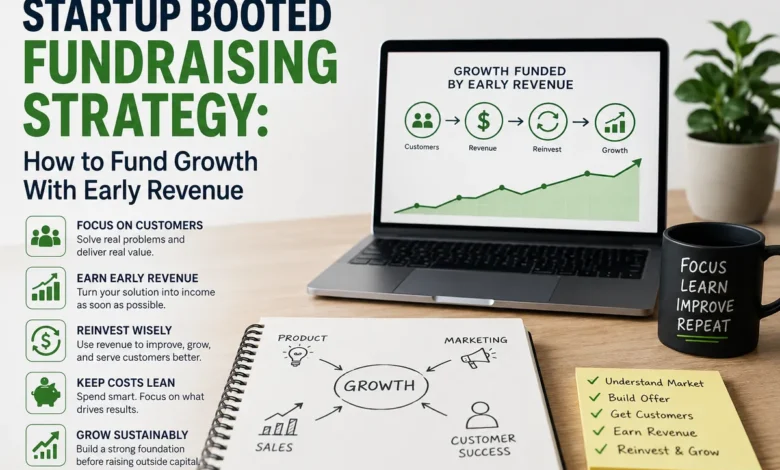
A startup does not always need a large investor round to begin moving forward. Many strong companies start with a small budget, careful spending, and real sales from early customers.
A startup booted fundraising strategy focuses on using early revenue as the main fuel for growth. Instead of chasing money first, the founder works to sell, learn, improve, and reinvest.
This approach is useful for founders who want more control, less pressure, and a clearer path to profit. It is not always easy, but it can build a stronger business foundation.
For new founders in the U.S., UK, and other markets, this model can feel more realistic than waiting for a perfect pitch meeting. It lets progress begin with buyers, not promises. That can be powerful when capital is harder to access or founders want to move carefully.
What Startup Booted Fundraising Strategy Means
A startup booted fundraising strategy means building a company with limited outside money. The founder may use savings, customer payments, pre-sales, small loans, grants, or business income.
The main idea is simple. The business should prove that people are willing to pay before the founder spends heavily on hiring, ads, offices, or advanced tools.
This method is often linked with bootstrapping. It rewards discipline because every dollar must have a clear reason, and every decision must support growth or learning.
It also changes the founder’s mindset. Instead of asking, “How much can we raise?” the better question becomes, “What can we sell, deliver, and improve right now?”
Why Early Revenue Matters
Early revenue is more than money. It is proof that the market sees value in the product or service. Paying customers give stronger feedback than casual opinions.
When a customer pays, the founder learns what problem matters most, what price feels fair, and what feature or service should be improved first.
Revenue also reduces fear. Even a small steady income gives the business room to test ideas without depending fully on investors, family, or debt.
This is why early revenue can be a better signal than praise. People may like an idea for free, but payment shows that the solution has real business value.
Start With a Clear Customer Problem
The best funded-by-revenue startups begin with a painful customer problem. The problem should be specific enough that people want a solution soon, not someday.
Founders should talk to real users before building too much. These talks help reveal what people already try, what they dislike, and what result they would pay for.
A clear problem also keeps spending under control. Instead of creating a large product, the team can build the smallest useful version and charge for it early.
The problem should also be easy to describe. If customers do not quickly understand what is being solved, the founder may spend too much time explaining and too little time selling.
Build an Offer People Can Buy Soon
A booted business needs an offer that can reach the market quickly. This may be a simple service, a paid consultation, a basic software version, or a product bundle.
The first offer does not need every planned feature. It only needs to solve one real problem better, faster, or more simply than the customer’s current option.
Speed matters because early sales teach the founder what to keep, remove, or change. The faster the offer meets paying users, the faster the business learns.
Many founders start with a hands-on version before building automation. Manual delivery may feel less exciting, but it can reveal what customers truly value before costly development begins.
Use One Short Money Plan
A simple money plan helps founders avoid waste. It should show how much cash is available, how long it can last, and what income target must be reached.
The plan should be reviewed often because early businesses change quickly. Costs may rise, customers may pay late, or a better sales channel may appear.
A useful plan can include only the most important numbers:
- Monthly fixed costs and expected sales
- Customer cost, gross margin, and cash runway
- The amount that can be safely reinvested
This plan should be short enough to use every week. If it is too complex, the founder may avoid it until problems become urgent.
Reinvest Revenue in the Right Places
Early income should not disappear into random tools or nice-to-have extras. It should go toward actions that improve sales, delivery, customer retention, or product quality.
The smartest reinvestment areas are often simple. Better customer support, a stronger landing page, faster delivery, useful product fixes, and direct sales work can all create returns.
Founders should ask one question before spending: will this help us earn more, serve customers better, or reduce a painful bottleneck within the next few months?
Reinvestment should follow evidence. If referrals bring better customers than ads, improve the referral process. If support issues hurt renewals, fix the product or service experience first.
Keep Costs Lean Without Looking Cheap
Lean spending does not mean poor quality. It means buying only what the business needs right now and avoiding commitments that are hard to reverse.
Founders can use simple tools, remote work, freelancers, shared services, and manual processes until demand becomes steady. This keeps the company flexible during uncertain early months.
The customer should never feel the business is careless. Save money behind the scenes, but protect the parts customers touch, such as support, security, delivery, and reliability.
A lean company can still look professional. Clear communication, on-time delivery, and honest promises often matter more than a fancy office or expensive brand package.
Price for Cash Flow and Trust
Pricing is a key part of funding growth with revenue. If the price is too low, the business may look busy while still running out of cash.
A good price should reflect the value delivered, the cost of serving the customer, and the need for future improvement. It should also be easy to explain.
Founders can test simple pricing levels with early customers. Honest feedback and payment behavior will often show whether the price feels fair, confusing, or too weak.
It can help to offer a clear starter plan and a stronger paid option. This gives careful buyers a way in while letting serious customers choose more value.
Use Pre-Sales Carefully
Pre-sales can help a founder raise cash before a full launch. Customers pay early because they believe the offer will solve an important problem.
This works best when expectations are clear. The founder should explain what the customer will receive, when it will arrive, and what happens if plans change.
Pre-sales should not be used as a promise machine. They are helpful only when the team can deliver with care and keep trust during the building process.
A founder can also use deposits for custom work, pilot programs, or limited early access. This lowers cash pressure while proving that the buyer has real interest.
Consider Small Funding Options When Needed
A revenue-first path does not mean refusing all outside money. It means using outside support only when it fits the business and does not create harmful pressure.
Some founders may use small business loans, grants, revenue-based funding, or customer contracts to support growth. These options can help when demand is clear but cash is tight.
The best time to seek extra funding is when the business already knows where the money will go and how it can help create more income.
Founders should compare repayment terms, ownership impact, and timing. Money that looks helpful today can become stressful later if the business has uneven cash flow.
Know When Investor Money Makes Sense
Investor money may be useful when the market is large, speed is critical, and the company needs to build faster than revenue alone allows.
Outside capital can help with hiring, product development, market entry, or major expansion. But it can also bring reporting pressure, shared control, and growth expectations.
Founders should compare the cost of giving up ownership with the benefit of faster growth. The right choice depends on the market, goals, and risk level.
A booted start can make later fundraising stronger. When a startup already has paying customers, the founder can discuss real numbers instead of only ideas.
Common Mistakes to Avoid
One common mistake is building too much before selling. A founder may spend months on features, branding, or systems without proving that customers will pay.
Another mistake is confusing revenue with profit. A business can make sales and still lose money if delivery costs, refunds, support, or paid ads are too high.
The third mistake is waiting too long to ask for help. Mentors, accountants, legal support, and experienced operators can prevent expensive problems before they grow.
Founders should also avoid copying another company’s path without context. A strategy that works for a funded software company may not fit a local service or product startup.
A Simple 90-Day Action Plan
The first 30 days should focus on customer discovery and offer design. Speak with potential buyers, study their pain points, and shape a simple paid offer.
The next 30 days should focus on selling and delivery. Try direct outreach, referrals, small content tests, and simple demos while improving the offer from real feedback.
The final 30 days should focus on numbers and reinvestment. Review sales, profit, repeat customers, and time spent, then put revenue into the area with the clearest return.
This plan is not meant to be perfect. It gives the founder a practical rhythm: listen, sell, deliver, measure, and improve before spending bigger amounts.
Final Thoughts
A startup booted fundraising strategy is not about staying small forever. It is about growing with proof, discipline, and customer money before making larger financial moves.
This path gives founders a closer link to the market. Every sale, complaint, renewal, and referral becomes a guide for what the business should do next.
For many early companies, revenue is the cleanest form of funding. It builds trust, keeps choices open, and helps founders grow with less noise and more control.
The best result is not just a company that survives. It is a company that understands its customers, respects cash, and can choose future funding from a position of strength.
Frequently Asked Questions (FAQs)
What is a startup booted fundraising strategy?
It is a way to fund a startup using early revenue, savings, and careful spending instead of depending first on large outside investment. The goal is to prove demand, protect control, and grow with real customer payments.
Is bootstrapping better than raising investor money?
Bootstrapping is better for founders who want control, slower risk, and a strong profit focus. Investor money may be better when the business must grow very fast or enter a highly competitive market.
How can early revenue fund business growth?
Early revenue can pay for product improvements, support, marketing tests, better tools, and new team help. The key is to reinvest money into actions that clearly improve sales, retention, or delivery.
What kind of startup can use this method?
Service businesses, software products, online tools, education brands, agencies, marketplaces, and niche products can all use this method. It works best when customers can pay early and the first version is not too costly to build.
What is the biggest risk of this approach?
The biggest risk is slow growth if the business cannot earn enough cash soon. Founders must manage money carefully, sell early, and avoid spending on things that do not help revenue or customers.
When should a booted startup seek outside funding?
A booted startup should consider outside funding when demand is proven and extra money can speed up growth in a clear way. It should not be used to hide weak sales or unclear customer demand.
Read More: Willowmagazine.co.uk