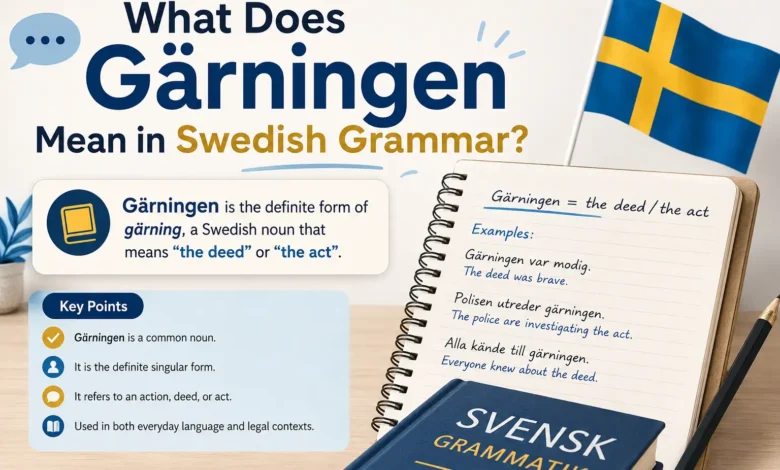
Gärningen is a Swedish word that often confuses learners because it looks specific, serious, and a little hard to pronounce at first. The simple meaning is “the deed,” “the act,” or “the action.” It points to something that has been done, not just something planned or imagined.
The word becomes easier when you break it into parts. The base word is gärning, which means a deed or act. The ending -en turns it into the definite form, so it means “the deed” rather than “a deed.”
This article explains how Gärningen works in Swedish grammar, how it differs from gärning, and how it appears in daily language, formal writing, and legal context. The goal is to make the word clear without making Swedish grammar feel heavy.
For English speakers, the most important idea is this: Swedish often adds meaning to the end of a word. Once you notice that pattern, Gärningen becomes more than one word to memorize. It becomes a small lesson in how Swedish nouns work.
Table of Contents
ToggleGärningen Meaning in Simple English
Gärningen usually means “the deed” or “the act.” It refers to one specific action that someone has done. In English, you often need the word “the” because Swedish has already built that meaning into the end of the word.
For example, en gärning means “a deed.” Gärningen means “the deed.” That small change matters because it tells the reader that the speaker already knows which action is being discussed.
The word can be neutral, positive, or negative depending on context. A good deed can be a helpful act. A bad deed can be a harmful act. In a legal sentence, the same word may point to the act connected with an offense.
Because of this, you should not translate it in only one fixed way. Sometimes “the act” sounds better in English. Sometimes “the deed” sounds more natural. In formal text, “the action” may be the clearest choice.
This flexible meaning is one reason the word appears in many kinds of Swedish writing. You may see it in a simple story about kindness, a news report about an event, or a serious discussion about responsibility. The surrounding words tell you which tone is intended.
How the Grammar Form Works
In Swedish, many nouns have an indefinite form and a definite form. English usually uses separate words like “a” and “the.” Swedish often attaches the definite article to the end of the noun.
That is what happens with gärning. The word starts as en gärning, meaning “a deed” or “an act.” When it becomes definite, the article moves to the end, creating gärningen.
You can remember the pattern like this:
- en gärning means a deed
- gärningen means the deed
- gärningar means deeds
- gärningarna means the deeds
Gärning is a common-gender noun, which is why it uses en in the singular indefinite form. Its definite singular ending is also connected to that en pattern. This is a common part of Swedish noun grammar.
The form also shows that Swedish nouns carry more information than many English learners expect. A single Swedish word can show whether the speaker means one thing, more than one thing, a general thing, or a specific thing. That is why learning the noun forms is so useful.
Gärningen vs Gärning
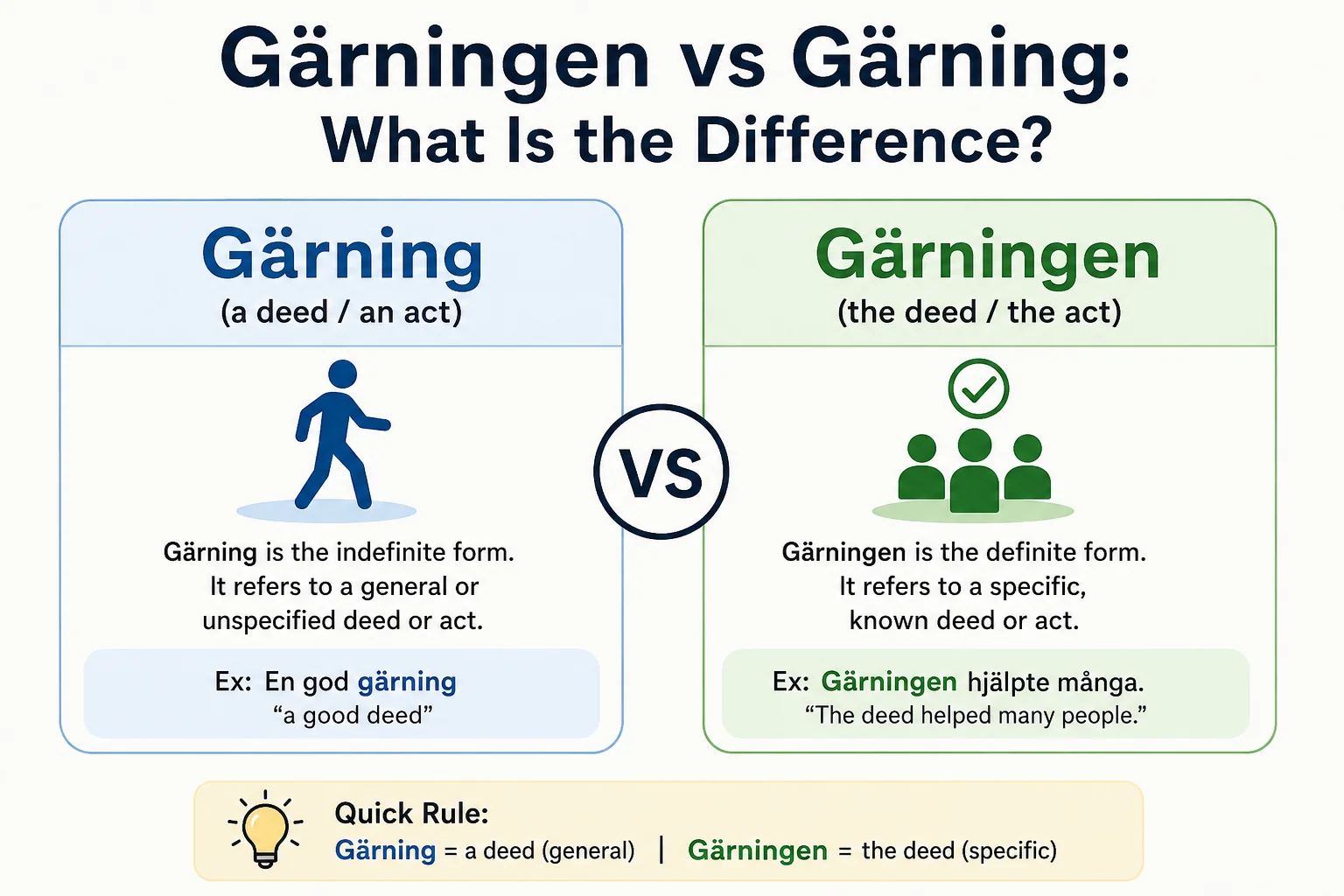
The difference between gärning and Gärningen is mostly about definiteness. Gärning is general. It can introduce a deed for the first time. Gärningen points back to a known or specific deed.
Think of English. You might say, “He did a deed.” After that, you might say, “The deed was brave.” Swedish works in a similar way, but the word ending does some of the work.
Gärning can also appear in set expressions, moral discussions, and broad statements about human action. It does not always point to one known event. It may describe a type of act or a general idea.
Gärningen feels more direct. It asks the reader to think about one action in particular. That is why it often appears after the event has already been mentioned or when the context makes the action clear.
A learner can test the difference by asking, “Could I say the deed in English here?” If the answer is yes, the definite Swedish form may be the better fit. If the idea is still general, the base form may sound more natural.
How to Use Gärningen in Sentences
The best way to understand Gärningen is to see how it works inside a sentence. Swedish word order can be different from English, but the noun still behaves like a normal noun. It can be the subject, object, or part of a longer phrase.
A sentence may discuss who did the deed, when the deed happened, or why the deed mattered. In English, the translation changes depending on which meaning sounds smooth. “The deed,” “the act,” and “the action” can all be right.
For example, if someone writes that Gärningen var modig, a natural English translation is “The deed was brave.” If the context is more formal, “The act was brave” may also work.
In learning Swedish, it helps to focus on the role of the word instead of memorizing only one English match. Ask what action the sentence is talking about. Then choose the English word that fits the tone.
You may also see the word after verbs that describe judgment, discovery, proof, or reaction. A writer might describe the deed as serious, kind, planned, careless, or brave. The adjective around it often gives the real clue to meaning.
Common Contexts and Related Words
Gärningen can appear in everyday speech, school writing, news reports, religious language, and legal discussion. The tone changes with the setting. In casual speech, it may simply mean a thing someone did. In formal writing, it may carry more weight.
One well-known related idea is god gärning, meaning “good deed.” This is used when someone helps another person or does something kind. When that deed becomes specific, a speaker may refer back to it as gärningen.
The word can also appear near terms such as handling, dåd, brottslig handling, and verk. These words do not all mean exactly the same thing. Handling is often “action.” Dåd can mean “deed,” but may sound dramatic or serious. Verk can mean “work” or the result of someone’s effort.
In crime-related language, the word may describe the act itself rather than the person. This does not mean the word is always negative. It simply means Swedish can use the same noun for an action in many different settings.
This range makes the word useful but also easy to misunderstand. A reader should not decide the meaning from the word alone. The sentence, topic, and tone all matter. That is especially true when moving between Swedish and English.
Pronunciation, Spelling, and Learner Mistakes
The spelling Gärningen includes the Swedish letter ä. This letter is not the same as plain a. In English terms, it can sound somewhat like the vowel in “air” or “bed,” depending on accent and surrounding sounds.
The letter ä matters because garning without the dots is not the same Swedish word. If you are writing for accuracy, keep the dots. Small marks can change meaning, pronunciation, and how natural the word looks to Swedish readers.
Another mistake is translating Gärningen as “doing” every time. The idea is related to doing, but the noun usually means the result or fact of an act. “The deed” or “the act” is usually more accurate.
Learners may also forget that Swedish uses endings where English uses separate articles. The -en ending is not random. It gives the word its “the” meaning. Once you understand this, many other Swedish nouns become easier too.
Capitalization is another small point. In normal Swedish, the word is written gärningen unless it begins a sentence or appears in a title. English-style title capitalization should not be copied into ordinary Swedish sentences.
Why This Word Matters for Swedish Learners
Gärningen is worth learning because it shows a pattern that appears across Swedish. When you understand how one noun changes from general to specific, you can use the same idea with many other words. This makes reading Swedish less slow and less confusing.
It also teaches you to look beyond direct translation. English may use a separate article, while Swedish may use an ending. That difference is small on the page, but it changes the whole meaning of the noun.
The word also connects grammar with real communication. It is not only a textbook form. It can appear in stories, news, study materials, and serious public writing. That makes it a practical word for learners who want to understand both simple and formal Swedish.
Another helpful point is that the word trains your eye to notice endings. Many learners read Swedish too quickly and miss the final letters. With words like this, the ending tells you whether the writer means a general idea or one specific thing.
When you build that habit, Swedish becomes easier to follow. You begin to see why small forms matter, and you become better at choosing natural English translations without losing the original meaning in both simple sentences and more careful reading tasks too.
Final Thoughts on Gärningen
Gärningen is a useful word because it teaches more than one piece of Swedish at the same time. It shows meaning, noun form, definiteness, and context. It also helps learners see how Swedish builds grammar into word endings.
The simplest translation is “the deed” or “the act.” Still, the best English choice depends on the sentence. A moral story may use “deed.” A legal report may use “act.” A plain explanation may use “action.”
The main point is that the word refers to one known action. It is not just any deed. It is the deed being discussed, judged, described, or explained.
Once you understand that, Gärningen becomes much less confusing. It is a clear example of how Swedish can carry meaning through a small ending while still expressing a very specific idea.
For learners, the best approach is to study the word together with its family forms. Learn en gärning, gärningen, gärningar, and gärningarna as a set. This will make your Swedish reading smoother and help you notice the same pattern in many other nouns.
Frequently Asked Questions (FAQs)
What does Gärningen mean in English?
Gärningen usually means “the deed,” “the act,” or “the action.” The best translation depends on the sentence, but it always points to a specific action that has already been identified or understood.
Is Gärningen the same as gärning?
No, they are closely related but not the same form. Gärning means “a deed” or “deed” in a general way, while Gärningen means “the deed” because it is the definite singular form.
Why does Gärningen end in -en?
It ends in -en because Swedish often places the definite article at the end of a noun. Since gärning is an en-word, its definite singular form becomes gärningen.
Can Gärningen be used in legal Swedish?
Yes, it can appear in legal or crime-related language when talking about the act involved in an event. However, the word itself is not only legal; it can also be used in normal and moral contexts.
How do you pronounce Gärningen?
The first vowel uses the Swedish letter ä, which is different from plain a. A simple learner-friendly guide is to say it with a front vowel sound, somewhat close to “air” or “eh,” though exact pronunciation depends on accent.
What is the plural form of gärning?
The indefinite plural form is gärningar, meaning “deeds” or “acts.” The definite plural form is gärningarna, meaning “the deeds” or “the acts.”
Read More: Willowmagazine.co.uk
 Admin
Send an email
May 27, 2026
Admin
Send an email
May 27, 2026