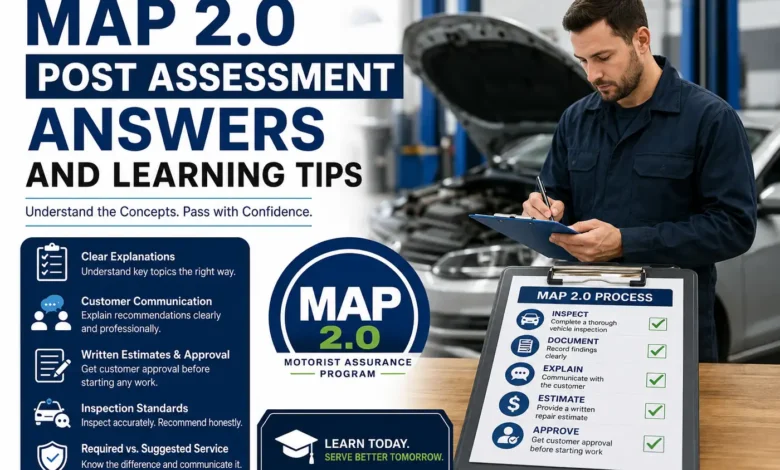
Many learners look for map 2.0 post assessment answers because they want to pass with confidence. That is easy to understand. A post assessment can feel stressful, especially when it comes after training, workplace learning, or an automotive service module.
Still, the best way to use this topic is not to copy answers. It is to understand the ideas behind the assessment. When you know why a choice is right, you can handle new questions, workplace situations, and follow-up training much better.
In most common training discussions, MAP 2.0 is linked with the Motorist Assurance Program. This program focuses on fair vehicle inspection, clear repair communication, customer approval, and consistent service standards in auto repair.
This guide explains what the assessment usually checks, how to study the main ideas, and how to think through questions in a safe and honest way. It is written for learners, service advisors, technicians, and anyone trying to understand MAP-style training.
Table of Contents
ToggleWhat Is MAP 2.0?
MAP 2.0 usually refers to an updated training or learning system connected with MAP standards in the automotive service field. The main goal is to help repair shops, technicians, and service teams communicate vehicle needs in a clear and consistent way.
The program is not only about repairs. It is also about trust. Customers often feel unsure when they hear that a vehicle needs work, so the MAP process helps service teams explain what was inspected, what was found, and why a service is required or suggested.
MAP 2.0 training often teaches learners how to follow a set process instead of making random recommendations. This matters because a customer should be able to understand the condition of the vehicle before approving any repair.
What Is a Post Assessment?
A post assessment is a test taken after a learning module, course, or training session. Its job is to check whether the learner understood the key ideas. It does not only check memory. It also checks judgment.
In a MAP 2.0 setting, the post assessment may ask about customer communication, repair recommendations, inspection steps, written estimates, and the difference between required and suggested service. These are practical topics used in real service situations.
The word “answers” can mean different things here. Some people mean a direct answer key, while others mean clear explanations. This article focuses on helpful explanations, because those are more useful and more responsible than copied test responses.
Why People Look for MAP 2.0 Post Assessment Answers
People often look for help because they feel short on time. A technician may be busy, a student may be nervous, or a service advisor may want to pass a training module quickly. That pressure can make answer pages look tempting.
The problem is that copied answers do not build skill. If the question changes slightly, the learner may still get it wrong. More importantly, MAP-style training is connected to real customer trust, so weak understanding can lead to poor communication later.
A better approach is to learn the pattern behind the questions. Most MAP 2.0 post assessment questions test whether you understand the purpose of inspections, documentation, customer choice, and honest recommendations.
Why There Is No Safe Universal Answer Key
There is no single safe answer key that works for every MAP 2.0 post assessment. Training providers may change question order, wording, answer choices, and module content. Some learners may also see different versions based on their course or workplace system.
Using a copied answer list can also create problems. It may be outdated, incomplete, or simply wrong. Many online pages repeat answers without explaining the standard behind them, which can lead to confusion.
The safer path is to understand the rule behind each question. When you know the reason, you can choose the best answer even if the wording is new. That is how real learning happens.
Key Topics Usually Covered in MAP 2.0
The assessment often checks the learner’s understanding of inspection standards and customer communication. It may also test how service recommendations should be made and explained.
Common learning areas include:
- Written repair recommendations and written estimates
- Customer approval before work begins
- Clear inspection results and documentation
- Required service versus suggested service
- Honest communication based on vehicle condition
These topics are important because they protect both the customer and the repair facility. A clear process reduces confusion, improves trust, and helps everyone understand what work is being recommended.
Understanding “Required” and “Suggested” Service
One of the most important MAP ideas is the difference between required and suggested service. A required repair usually means the part or system no longer works as intended, does not meet a needed condition, or may create a safety or performance concern.
A suggested service is different. It may be useful because a part is near the end of its service life, because the customer requested it, or because it can improve convenience or prevent a future issue. Suggested does not mean the same thing as urgent.
Many assessment questions are built around this difference. When reading a question, ask whether the condition creates a present need or only a recommendation for future attention. That simple step can help you avoid many mistakes.
Customer Approval and Written Communication
MAP training places strong attention on customer approval. A repair shop should not begin work before the customer understands the recommendation and gives permission. This is one of the clearest ideas learners should remember.
Written communication also matters. Verbal explanations are helpful, but written estimates and recommendations create a clear record. They help the customer review the repair plan and reduce misunderstandings later.
In a post assessment, any answer choice that supports clear written communication, customer understanding, and prior approval is often connected with the main MAP purpose. Still, always read the full question before choosing.
Inspection Standards and Real Vehicle Conditions
MAP-style questions often connect recommendations to inspection results. This means a service should not be recommended only because it sounds common or profitable. It should be tied to an actual vehicle condition, a standard, or a customer need.
For example, if a component is worn beyond an acceptable condition, the recommendation may be stronger. If the part is still working but close to a future service point, the recommendation may be suggested instead of required.
This is why learners should study the logic of inspection categories. The assessment wants to know whether you can match the customer’s vehicle condition with the correct type of recommendation.
How to Study Without Copying Answers
The best study method is simple. Review the training module, then write down the main rule from each section in your own words. This helps your brain remember the reason, not just the wording.
After that, practice with scenario thinking. Imagine a customer brings in a vehicle, the technician inspects a system, and the advisor must explain the result. Ask yourself what should be written, what should be said, and what needs customer approval.
You can also review missed questions by topic. Do not only ask, “What was the right answer?” Ask, “What idea did I miss?” That small change makes your study time much more useful.
How to Read MAP 2.0 Questions Carefully
Many learners lose points because they rush. MAP 2.0 questions may include small wording differences that change the best answer. Words like must, should, required, suggested, approve, inspect, and document are important.
Read the question once for the situation, then read it again for the action being tested. Is the question asking about what the technician does first? Is it asking what the customer must receive? Is it asking what a door decal or program pledge means?
Do not choose an answer only because it sounds familiar. Choose the one that matches the process: inspect, document, explain, estimate, and get approval before work is performed.
Smart Learning Tips for Better Results
A strong score comes from steady review, not last-minute guessing. Spend a short amount of time on the main ideas each day instead of trying to memorize everything at once.
It also helps to connect each rule to a real shop example. Think about how a customer would feel if a repair was started without approval, or if a recommendation was unclear. That makes the rule easier to remember.
If your training system gives feedback, use it carefully. Feedback can show whether you are weak in communication, documentation, service categories, or customer approval. Focus your review on the area that repeats most.
Common Mistakes Learners Should Avoid
One common mistake is treating every recommendation as required. In real service communication, that can create pressure and confusion. The correct choice depends on the condition found during inspection.
Another mistake is ignoring the customer’s right to choose. MAP-style training places customer understanding and approval at the center of the process. The customer should know what is being recommended and why.
A third mistake is trusting random online answers without checking the concept. Even if one copied answer happens to be right, it may not help with the next version of the test. Understanding is safer than memorizing.
Who Can Benefit from This Guide?
This guide can help automotive students who are new to service standards. It can also help technicians who need to complete training for work or review the main MAP 2.0 ideas before an assessment.
Service advisors may find it useful because many questions involve customer communication. Advisors often need to explain inspection results, estimates, and recommended repairs in a calm and clear way.
Shop owners and managers can also use these ideas for team training. When everyone follows the same process, customers get a more consistent experience, and staff members feel more confident explaining repairs.
Final Thoughts
MAP 2.0 post assessment answers are best understood as learning support, not a shortcut. The goal is not only to pass a test. The real goal is to understand fair inspection, clear communication, and customer-focused repair recommendations.
When you study the purpose behind each question, the assessment becomes less confusing. You start to see that most answers connect back to the same core ideas: inspect properly, document clearly, explain honestly, and get customer approval.
If you are preparing for the assessment, focus on the standards and the meaning behind each scenario. That approach will help you perform better and use the knowledge in real automotive service work.
Frequently Asked Questions (FAQs)
What is MAP 2.0 post assessment?
A MAP 2.0 post assessment is usually a test taken after MAP-related training. It checks how well a learner understands inspection standards, customer communication, repair recommendations, and approval steps.
Can I find exact MAP 2.0 post assessment answers online?
You may find pages claiming to show exact answers, but they may be outdated, incomplete, or not matched to your version. It is safer to study the concepts so you can answer correctly even when questions are changed.
What does MAP 2.0 teach in automotive training?
MAP 2.0 commonly teaches fair inspection practices, written recommendations, clear estimates, and honest communication with customers. It helps service teams explain repairs based on real vehicle conditions.
How can I prepare for the MAP 2.0 post assessment?
Review the training material first, then focus on the main rules behind each topic. Pay special attention to customer approval, written estimates, required service, suggested service, and inspection documentation.
Why are required and suggested services important?
They help the customer understand how serious a repair need is. Required service usually points to a stronger present need, while suggested service may relate to future care, convenience, or a customer request.
Is it wrong to use MAP 2.0 post assessment answers for studying?
It depends on how you use them. Using explanations to learn is helpful, but copying a test answer key is risky and may break training rules. The better choice is to learn the reason behind each answer.
Read More: Willowmagazine.co.uk
 Admin
Send an email
June 10, 2026
Admin
Send an email
June 10, 2026