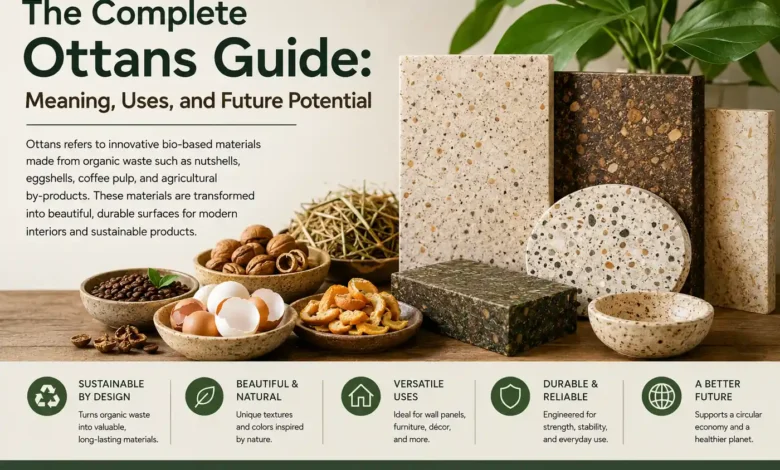
Ottans is a term now appearing in discussions about responsible draws interest because it connects common food or farm by-products with useful surfaces for homes, offices, stores, and furniture.
The name can also confuse readers because it has no single meaning in standard English. In this guide, Ottans refers mainly to the material idea associated with Ottan, a company that turns food and agricultural remains into decorative composite surfaces. The official brand name does not include the final “s.”
That distinction keeps the topic clear without inventing a dictionary definition. This article explains the idea, production process, possible uses, benefits, limits, and future potential of these waste-based materials.
The subject is especially relevant to people interested in interior design, responsible manufacturing, waste reduction, and new building products. It also helps ordinary buyers understand why a material’s story must be supported by practical performance.
What Is Ottans?
Ottans can be understood as a general label for bio-based surfaces made partly from discarded organic matter. Instead of treating nutshells, eggshells, plant fibers, or food-processing remains as useless, the material system gives selected waste a second purpose.
The waste is cleaned, prepared, blended with a binding material, and formed into panels or shaped products. These are not simply dried scraps pressed together. A commercial surface needs stable dimensions, a suitable finish, and enough strength for its intended setting.
The main goal is to use existing resources more wisely before extracting new ones. This supports circular production, where unwanted matter becomes an input for another product rather than going directly to disposal.
Why the Name Causes Confusion
The exact word Ottans is not a common English dictionary term. It may appear as a spelling variation, surname, place name, or word form in another language. People may also confuse it with “ottomans,” meaning upholstered footstools or people linked with the Ottoman Empire.
The name also appears in Alpine geography, including the Col des Ottans and nearby mountain routes. Those locations have no connection with sustainable panels, furniture, or circular manufacturing.
This guide uses the word only for the modern material topic connected with Ottan. When researching a product, confirm the official spelling, maker, product name, and intended use. One added letter can lead to a completely different subject.
The Main Idea Behind Ottans
The idea starts with a common problem. Farms, food processors, stores, and restaurants produce large amounts of shells, peels, fibers, pulp, and other organic remains. Some can be composted or used for energy, while selected streams may suit higher-value material uses.
Turning those remains into design surfaces can extend their useful life. It may also lower demand for some newly mined, cut, or petroleum-based inputs. The aim is not to claim that one panel will solve the waste crisis, but to create another practical use for suitable by-products.
Natural differences in color and texture can become design features instead of flaws. The best results appear when attractive looks, reliable performance, responsible sourcing, and realistic costs work together. A product that fails early would create more waste.
This is why circular design is about more than using leftovers. It requires careful choices at every stage, from collection and processing to installation, repair, reuse, and final recovery.
How Ottans Materials Are Made
Production begins with collecting suitable by-products from known sources. The material is sorted to remove packaging, dirt, metal, and unwanted matter. Moisture must also be controlled because wet inputs can affect storage, consistency, odor, and long-term stability.
The clean waste may be dried, crushed, milled, or separated into chosen particle sizes. Fine powder creates a smoother look, while larger pieces form visible patterns. Producers can blend several waste types to change texture, color, or performance.
The particles are mixed with a binder and formed through pressure, heat, molds, or curing. Finished sheets may then be cut, sanded, sealed, polished, or shaped. Exact recipes differ, so binder type, coatings, recovered content, and disposal options should be checked for each product.
Common Organic Inputs
Food and farm by-products can offer useful colors, fibers, or hard particles. Shells may produce a stone-like pattern, while grass and leaves create a softer, fibrous look. Pale ingredients can help form light surfaces without covering their natural appearance.
Commonly discussed inputs include:
- Eggshells, hazelnut shells, pistachio shells, walnut shells, orange peel, coffee pulp, carrot pulp, grass, fallen leaves, grains, lentils, corn remains, and other clean plant-based by-products.
Not every waste stream is suitable. Inputs need safe handling, practical storage, steady supply, and dependable quality. Local sourcing may reduce travel and connect factories with nearby farms, but it still requires strong collection, drying, and quality-control systems.
Main Properties and Appearance
Ottans surfaces are often valued for visible natural character. Shell pieces, fibers, small speckles, and soft color changes can create a look similar to terrazzo, stone, cork, or handmade composites. Different formulas produce different patterns and levels of uniformity.
After sanding and finishing, a panel may feel smooth while its original particles remain visible. Some surfaces use neutral shades, while others keep colors from their ingredients. This helps the material show its source rather than imitate something else.
Performance must be judged product by product. Wall cladding does not need the same resistance as flooring, worktops, or exterior panels. Buyers should request details on fire behavior, moisture, scratches, cleaning, indoor emissions, lifespan, repair, and installation.
Practical Uses in Interiors and Products
Interior wall cladding is one of the clearest uses for Ottans. Panels can bring texture and a distinctive story to reception areas, shops, hotels, offices, restaurants, and homes. Decorative walls also place less mechanical stress on a material than floors or worktops.
Furniture is another promising area. Sheets may be used for tabletops, shelves, cabinet fronts, dividers, displays, and decorative parts. Designers can combine them with wood, metal, or glass to provide structure and visual contrast.
Smaller products may include trays, coasters, signs, lamps, boxes, handles, and branded display pieces. Every use should follow the producer’s guidance. A panel made for dry indoor furniture should not automatically be placed outside, near constant heat, or in a wet room.
Environmental and Business Benefits
The clearest benefit is using matter that might otherwise have little value. Upcycling can keep selected by-products in circulation and encourage better collection from farms or food businesses. It also shows that waste can become a useful design resource.
Bio-based content may reduce reliance on some virgin minerals, timber, or fossil-based materials. Still, the full impact depends on energy, transport, binders, coatings, durability, repair, and final disposal. A high waste percentage alone does not prove that a product has a low overall impact.
For businesses, natural patterns can create distinctive spaces without printed imitation. There may also be value in regional production using nearby waste and existing facilities. Actual savings depend on equipment, labor, quality control, volume, and transport.
Limits and Questions Buyers Should Consider
A strong sample does not guarantee reliable large-scale supply. Commercial projects need consistent sheets, accurate sizes, stable lead times, clear fitting methods, replacement stock, and support when problems occur. New materials must prove they can meet these practical needs.
Buyers should examine what binds the organic particles together. A product may contain a high share of waste but still use a binder or coating that affects emissions, recycling, or disposal. Broad environmental claims should be supported by details for the exact item.
Cost, maintenance, and long-term evidence also matter. Collecting and preparing many waste streams can be expensive. Architects may need warranties, test reports, cleaning advice, and proof of durability before approving a material for busy spaces.
Ottans Compared With Conventional Surfaces
Compared with virgin plastic surfaces, Ottans may contain more recovered or bio-based matter and offer a less synthetic appearance. Its particles create real texture rather than a printed copy of stone or wood. However, resistance to heat, water, impact, and chemicals must be verified.
Compared with natural stone, a composite panel may be lighter and easier to shape for some projects. It can also reduce new quarrying. Stone, however, has a long performance record and may be better for heat, weather, or heavy wear.
Compared with solid wood, waste-based sheets can use by-products without cutting new boards. Wood still offers familiar repair methods and structural qualities. A fair choice should consider lifespan, maintenance, travel distance, installation waste, repair, and what happens after removal.
Industries That Could Adopt Ottans
Architecture and interior design are likely early markets because surfaces affect both appearance and environmental goals. Hotels, restaurants, stores, offices, galleries, and cultural spaces can use panels as visible features that invite questions about their origin.
Furniture and product makers may begin with limited collections, cabinet fronts, custom pieces, or decorative parts. Smaller projects allow teams to learn how the material cuts, joins, finishes, and performs before committing to large production runs.
Food companies could use their own clean processing remains in displays, counters, meeting-room furniture, or branded objects. Transport, exhibitions, and consumer goods may also find uses, provided the material meets rules for fire, impact, hygiene, cost, and supply.
Future Potential of Ottans
The future of Ottans depends on moving from attractive design samples to dependable material systems. Growth requires repeatable formulas, verified performance, competitive prices, stable supply, and clear instructions for installers, designers, and fabricators.
Modern cutting and molding methods may allow panels to become custom shapes, fitted components, or textured surfaces with less offcut waste. Better recovery programs could return workshop scraps and removed panels into new production rather than sending them to disposal.
Regional production is another opportunity. Different areas generate different shells, skins, husks, and fibers. Local formulas could reflect regional agriculture while shortening supply routes. The larger goal is a manufacturing culture that sees suitable organic remains as feedstock, not merely rubbish.
Improved testing and clearer labeling could also build trust. Buyers are more likely to choose unfamiliar materials when performance, ingredients, care needs, and recovery options are easy to compare.
Final Thoughts
Ottans is best understood as a modern spelling used around the idea of turning food and agricultural waste into useful design materials. The official company name connected with this work is Ottan, while the form with an added “s” often appears informally online.
Its appeal is easy to understand. Discarded shells, fibers, and plant matter can become wall panels, furniture surfaces, dividers, displays, or small products instead of losing all value after their first use.
Careful evaluation remains essential. Buyers should examine ingredients, binders, coatings, test results, installation limits, maintenance, lifespan, and end-of-life plans. The long-term success of Ottans will depend on durability, honest claims, practical pricing, and reliable production.
Used thoughtfully, the concept offers a clear lesson: materials do not need to begin with newly extracted resources. Some of tomorrow’s useful surfaces may begin as yesterday’s shells, fibers, and food-processing remains.
Frequently Asked Questions (FAQs)
What does Ottans mean?
Ottans is often used online as a spelling variation connected with Ottan, a material concept that uses food and agricultural by-products. It is not one standard English term, so context should always be checked.
Is Ottans the same as Ottan?
In circular-design discussions, both spellings may point to the same subject. Ottan is the official brand spelling, while Ottans may appear informally in titles, general articles, or user searches.
What is Ottans made from?
Possible inputs include eggshells, nutshells, fruit remains, grass, leaves, grains, and other selected organic by-products. The exact binder, mixture, finish, and amount of recovered matter vary between products.
Where can Ottans materials be used?
Possible uses include indoor wall panels, cabinet fronts, furniture surfaces, dividers, displays, and decorative objects. Suitability for wet rooms, floors, kitchens, exteriors, or heated areas must be confirmed separately.
Is Ottans environmentally friendly?
It can support waste recovery and reduce demand for some virgin inputs. Its full impact still depends on energy use, transport, binder type, coatings, lifespan, repair, and what happens after disposal.
What is the future of Ottans?
Future growth may come from interiors, furniture, retail, hospitality, and custom manufacturing. Wider adoption will require dependable testing, larger production capacity, clear standards, consistent supply, and prices that suit ordinary commercial projects.
Read More: Willowmagazine.co.uk