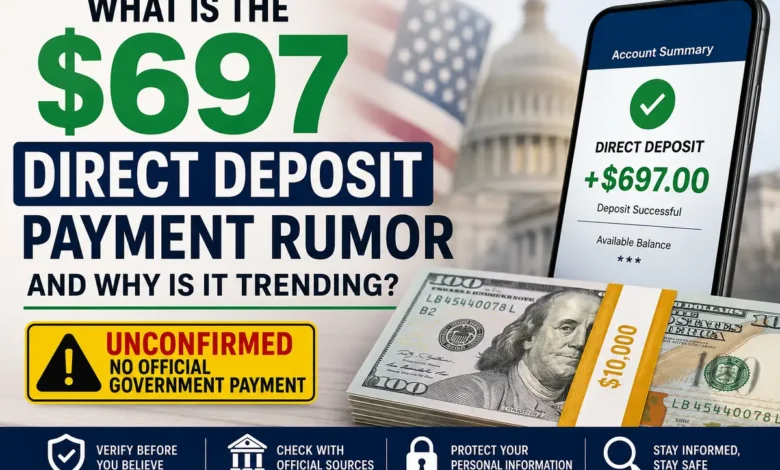
Claims about a new $697 payment have spread across social media, small news sites, video platforms, and private message groups. Many posts suggest that the money will arrive automatically through direct deposit. Some connect it to Social Security, tax relief, inflation support, or a new stimulus plan.
The attention is understandable. Household costs remain a concern for many people, and a specific dollar amount can sound more believable than a vague promise of “free money.” A headline that mentions a deposit date, eligibility, or automatic approval can quickly attract clicks and shares.
However, the rumored $697 direct deposit payment should not be treated as confirmed income. As of June 22, 2026, there is no verified nationwide U.S. program promising every eligible person a new payment of exactly $697. People should check the agency, program name, legal authority, and official payment schedule before believing any claim.
What Is the Rumored $697 Direct Deposit Payment?
The rumor describes a supposed one-time or monthly deposit of $697 sent to certain Americans. Depending on the post, the money is said to come from the federal government, the Social Security Administration, the Internal Revenue Service, or an unnamed relief program.
The details often change from one page to another. Some versions say seniors and disabled adults qualify. Others include low-income households, taxpayers, veterans, or anyone with a bank account already linked to a government agency.
That lack of agreement is an important warning sign. A real public benefit normally has a clear name, purpose, funding authority, eligibility rules, application process, and payment calendar. The $697 claim usually appears without those basic facts.
The number may also be presented as a “check,” even when the headline says direct deposit. This mixed language can make the claim sound broad enough to reach different groups while avoiding a precise explanation of who is paying the money.
Is the $697 Payment Real?
There is no confirmed federal program that guarantees a new $697 deposit to all Americans or to every Social Security recipient. No single payment amount applies to everyone because real benefits and refunds are usually based on personal records, income, work history, family size, disability status, taxes, or state rules.
A person can still receive a legitimate deposit totaling $697. That amount could be a tax refund, a corrected benefit, an insurance payment, payroll, state assistance, or a private transfer. The appearance of $697 in one bank account does not prove that a national program exists.
Readers should also separate a proposed bill from an approved payment. A lawmaker may discuss relief, a group may campaign for extra support, or a news story may cover an idea. None of those actions creates a payable benefit unless the proposal completes the required legal and administrative steps.
Why Is the Claim Trending?
Money stories travel quickly because they create hope, urgency, and fear of missing out. A person who is worried about rent, food, energy bills, or medical costs may share a payment post before checking whether it is accurate.
The exact figure also makes the story look official. A claim for $697 can feel more credible than a rounded claim for $700. Specific numbers are often used in misleading headlines because they appear to come from a calculation, benefit table, or private notice.
Online publishing also rewards attention. Pages may reuse the same topic with new dates, changed eligibility language, or phrases such as “approved,” “confirmed,” and “coming soon.” Repetition can make an unsupported claim appear established, even when every page traces back to another unverified post.
Where Could the $697 Figure Have Come From?
There is no single proven origin for the amount. It may have grown from a real individual payment, an average used in an older article, a benefit estimate, or a misunderstood bank screenshot. Once the number attracted attention, other pages could repeat it without confirming its source.
Social Security amounts differ widely. Retirement and disability payments depend on a person’s record, while Supplemental Security Income is affected by income, living arrangements, and other factors. A recipient might receive an amount near $697, but that would reflect an individual calculation rather than a universal bonus.
Tax refunds can also land near that figure. Refunds vary according to tax withheld, credits, filing status, income, and adjustments. A $697 refund would not establish a separate relief plan or mean that other taxpayers should expect the same amount.
Who Is Supposed to Qualify?
Viral posts commonly mention seniors, Social Security recipients, people receiving SSI or SSDI, veterans, low-income families, and taxpayers. Some claims add age limits or income ranges but fail to name the rule or document that created them.
These groups are frequently targeted because many already receive government payments. A false post can sound believable when it says an agency will use existing bank details and send money automatically.
Real eligibility is never decided by a viral headline. Each program has its own standards, and two people with similar ages or incomes may receive different amounts because their records and circumstances are not the same.
How Genuine Government Payments Are Announced
Legitimate payments are connected to a named program and a responsible department. The announcement normally explains why the payment exists, who qualifies, whether an application is required, and how recipients can ask questions.
Major programs also leave a public trail. There may be legislation, agency notices, budget documents, account updates, mailed letters, press releases, or detailed instructions. Dates and amounts are explained consistently rather than changing across unrelated websites.
A genuine agency will not require a gift card, cryptocurrency transfer, wire payment, or “release fee” before sending a benefit. It will not ask a person to move money to a safe account or share a verification code received from a bank.
Use this quick legitimacy check:
- Confirm the program’s full name; identify the paying agency; look for written eligibility rules and a dated schedule; verify the claim through an account or contact method you already know is genuine.
How Direct Deposit Actually Works
Direct deposit is only a delivery method. It moves money electronically into a bank or credit union account. It does not show that the payment is a stimulus check, a bonus, or a new public benefit.
Government agencies use information already connected to an approved account or application. For example, a person may receive Social Security benefits, a tax refund, veterans benefits, or another authorized payment electronically after completing the required process.
The bank description can help identify the payment. It may include an agency abbreviation, company name, payment type, or treasury code. Descriptions are not always easy to understand, so account holders should ask their bank or the relevant agency before spending an unexpected deposit.
Are There Payment Dates or a Status Check?
There is no official nationwide payment calendar for the rumored amount. Dates shown in viral articles are often copied from normal benefit schedules or changed each month to keep the story looking current.
Social Security, SSI, tax refunds, veterans benefits, and state assistance follow separate timetables. A person’s regular payment date does not prove that an additional $697 will arrive on the same day.
There is also no special public “$697 status checker.” Pages that ask for a Social Security number, bank account, password, card details, or payment to check eligibility may be collecting information for fraud.
People who already receive benefits should use the secure account and contact details associated with that program. Taxpayers should use established refund tools, while benefit recipients should review official notices and account history.
Scam Risks Linked to Payment Rumors
Scammers often contact people by text, email, social media, phone, or messaging apps. They may claim that a payment is waiting but needs to be activated, confirmed, insured, or released.
The request usually comes with pressure. The recipient may be told to act within hours, keep the message secret, or pay a small processing charge. A scammer may also impersonate a government worker and use official-looking logos or caller identification.
Never share a one-time bank code, online account password, full Social Security number, or debit-card PIN in response to an unexpected payment message. Do not click a link simply because it contains a government name or seal.
Anyone who already shared information should contact the bank immediately, change affected passwords, review account activity, and report identity theft or fraud through the proper national or local channels.
What to Do If $697 Appears in Your Account
First, do not assume the money is yours to spend. Banks can display pending deposits that later change or disappear. Incorrect deposits may also be reversed after the sender or bank discovers the error.
Read the transaction description and compare it with expected payroll, refunds, benefits, rebates, insurance payments, and transfers. Check recent letters, account notices, and approved claims that could explain the amount.
If the sender remains unclear, contact the bank using the number printed on the card or listed in the banking app. Do not use a phone number included in a suspicious text or email.
Do not send part of the deposit to another person who claims it was an overpayment. That is a common fraud pattern. Let the bank investigate and handle any reversal through its normal process.
What U.S. and UK Readers Should Understand
The rumor is mainly framed as a U.S. government payment. Readers in the UK should not assume that a dollar-denominated claim applies to them or that it represents a new cost-of-living payment.
Both countries provide real support through established departments, tax systems, pension programs, disability benefits, and local assistance. Names, payment rules, currencies, and application methods differ, so advice written for one country may be wrong for another.
People living outside the United States should be especially careful with posts that use American agency names while promising international eligibility. Most public benefits depend on residence, citizenship or immigration status, tax history, and program-specific conditions.
How to Plan While the Rumor Remains Unconfirmed
Do not add the expected $697 to a household budget. Plan only with income that is confirmed, scheduled, and connected to a known source. This reduces the risk of missed bills or unnecessary borrowing.
People facing financial pressure can review existing support instead of waiting for a viral payment. Depending on location and circumstances, help may be available for food, housing, energy, health care, taxes, disability, unemployment, or family needs.
Keep benefit and tax accounts secure and current. Accurate contact and banking information can prevent delays when a real payment is due. Strong passwords and two-step verification also reduce the risk of account takeover.
Final Thoughts
The rumored $697 direct deposit payment is trending because it combines a precise amount with a promise of quick financial relief. That message is easy to share and especially appealing when living costs are high.
At present, the claim does not represent a confirmed nationwide U.S. payment for seniors, low-income households, taxpayers, or all benefit recipients. A real deposit of the same amount may have another explanation, but it should be verified before use.
The most practical response is to remain calm, protect personal information, and rely on the agency or organization responsible for an existing payment. Do not pay a fee, disclose a bank code, or complete an unfamiliar form to unlock the money.
Financial assistance programs can change, so future announcements should be judged on their own facts. Until clear rules and an official schedule exist, the $697 story should be treated as an online rumor rather than guaranteed income.
Frequently Asked Questions (FAQs)
Is the rumored $697 direct deposit payment confirmed?
No. As of June 22, 2026, no verified nationwide U.S. program guarantees a new $697 payment to everyone or to every federal benefit recipient.
Are Social Security recipients getting an extra $697?
There is no confirmed universal $697 bonus for Social Security recipients. Regular benefit amounts depend on individual records and program rules.
Is there an application for the $697 payment?
There is no verified special application for this rumored payment. Avoid unfamiliar forms that request bank details, passwords, fees, or identity documents.
Could a real government deposit equal $697?
Yes. A legitimate refund, benefit adjustment, or other approved payment could total $697, but the amount alone does not prove a nationwide program exists.
What should I do after receiving a suspicious payment message?
Do not click its link or reply with personal information. Verify the claim independently through your existing agency account, bank, or a trusted official contact method.
Will the $697 payment be available in the UK?
The viral claim is generally presented as a U.S. payment and is not a confirmed UK benefit. UK residents should check support through the relevant government department.
Read More: Willowmagazine.co.uk