Most towns have one property market. Ayr has at least three, running side by side along the same stretch of Firth of Clyde coastline — and they barely resemble each other. Understanding which market you’re actually buying in is the difference between a smooth purchase and a mortgage application aimed at entirely the wrong lender.
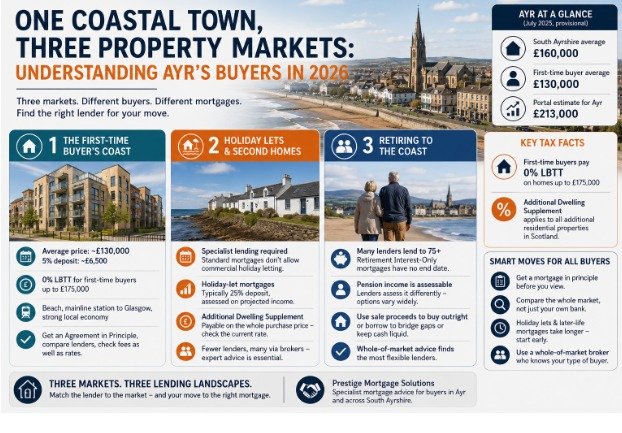
The headline figures first. Registers of Scotland put the average house price across South Ayrshire at £160,000 as of July 2025 (provisional), with first-time buyers paying an average of roughly £130,000. But portal estimates for Ayr itself run notably higher — around £213,000 — a gap that reveals the town’s split personality: an affordable inland and town-centre market coexisting with a premium coastal and seafront segment shaped by holiday demand and retirement relocation.
Market One: The First-Time Buyer’s Coast
Start with the most cheerful story. On the local first-time buyer average of about £130,000, a 5% deposit — the minimum most lenders accept — comes to roughly £6,500. That’s one of the lowest barriers to entry of any coastal town in Britain, for a place with a beach, a mainline station to Glasgow, and a working local economy.
Better still, Scotland’s Land and Buildings Transaction Tax gives first-time buyers a nil-rate threshold of £175,000 — comfortably above what most Ayr first-timers pay, meaning the tax bill for most is zero. The practical advice for this group is conventional but worth repeating: secure a mortgage in principle before viewing, compare beyond your own bank, and remember that on smaller loans, lender fees can matter as much as headline rates.
Market Two: Holiday Lets and Second Homes
Ayr’s seafront and the coastline around it have long attracted a different buyer: those purchasing a holiday home for their own use, or a holiday let as an income-generating investment. Both need to understand that this is specialist-lending territory.
A standard residential mortgage doesn’t permit commercial holiday letting, and a standard buy-to-let usually assumes six-month tenancies, not weekly bookings. Holiday-let mortgages are their own product class: lenders typically want a larger deposit (often 25%), and assess affordability on projected letting income across high, mid, and low seasons — usually evidenced by a letting agent’s projection. Fewer lenders operate here than in mainstream lending, and several deal only through intermediaries.
Second-home buyers face a further cost that catches many by surprise: the Additional Dwelling Supplement on top of standard LBTT, charged on the whole purchase price of any additional residential property in Scotland. It materially changes the arithmetic of a “wee place by the sea,” and it’s gone up more than once in recent years — check the current rate before you offer, not after.
Market Three: Retiring to the Coast
The third market is the retirement relocation: buyers in their fifties, sixties, and beyond, selling elsewhere and moving to the coast for the pace of life. Some buy outright with sale proceeds, but a substantial number want or need borrowing — to bridge a price gap, avoid selling investments at a bad moment, or keep cash liquid.
The persistent myth in this group is that mortgages end at retirement. In reality, many lenders now lend to 75 or beyond, retirement interest-only products have no fixed end date at all, and pension income is assessable for affordability — though every lender weighs it differently. The gap between the most and least flexible lenders on later-life criteria is wide enough that this group, above all, benefits from seeing the whole market rather than one bank’s policy.
The Common Thread: Match the Lender to the Market
Three markets, three lending landscapes — and almost no overlap in which lenders serve each best. That’s the real lesson of Ayr’s property scene. A whole-of-market broker such as Prestige Mortgage Solutions Ltd, which advises holiday-let purchasers, retirement relocators, and first-time buyers across Ayr and South Ayrshire, spends its time on precisely this matching problem: identifying which of the dozens of available lenders actually wants your kind of application, before any credit check is spent finding out the hard way.
Timing advice is common to all three groups too: start the finance conversation before falling for a specific property. Holiday-let projections, later-life affordability assessments, and first-time buyer approvals all take longer to arrange than a standard employed application — and Ayr’s better coastal properties don’t wait around.
The Bottom Line
Ayr in 2026 offers something genuinely unusual: a coastal town where a first home costs £130,000, a seafront investment property trades on holiday-season yields, and retirement buyers can still borrow well past pension age — all within the same postcode area. Whichever of its three markets you’re buying in, the rules, costs, and lenders differ enough that generic mortgage advice isn’t really advice at all. Book a FREE Appointment now at Prestige Mortgage Solutions Ltd to Know your market, budget for its particular taxes, and put your application in front of the lenders built for it.