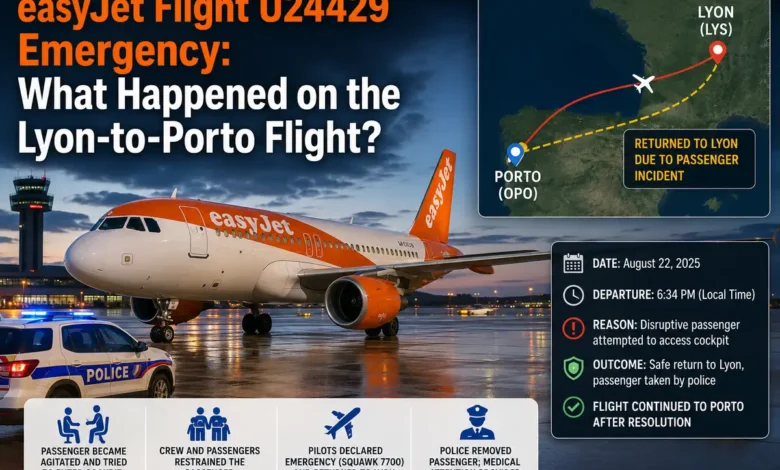
The easyJet Flight U24429 Emergency began as a routine evening trip from Lyon, France, to Porto, Portugal. Soon after takeoff on August 22, 2025, the aircraft turned back toward Lyon Saint-Exupéry Airport because of a serious passenger disturbance inside the cabin.
The passenger reportedly tried to force entry into the cockpit area. Cabin crew and other travelers helped control him while the pilots returned the Airbus A320 safely to the airport.
The plane landed without a reported aviation accident. Police met the aircraft, removed the passenger, and the service later continued to Porto. The known facts point to a security and medical event involving one traveler, not a mechanical failure of the aircraft.
This account explains the timeline, crew response, emergency signal, and passenger rights while separating confirmed facts from unsupported claims.
Quick Overview of Flight U24429
Flight U24429 connected Lyon Saint-Exupéry Airport with Francisco Sá Carneiro Airport in Porto. This short-haul journey usually takes a little more than two hours.
The aircraft was reported as an Airbus A320 registered OE-IJL. The service may also appear in tracking systems as EJU4429.
The main points are easy to follow:
- The flight departed Lyon on Friday, August 22, 2025.
- A 26-year-old Portuguese passenger caused a disturbance soon after takeoff.
- He reportedly attempted to enter the cockpit area.
- Crew members and passengers restrained him.
- The pilots returned to Lyon and landed safely.
- Police removed the passenger, who was later taken to a hospital.
- The flight eventually continued to Porto.
No public report identified a major aircraft failure. The return was connected to behavior in the cabin.
Timeline of the Lyon-to-Porto Incident
Public flight-tracking reports placed the departure at about 6:34 p.m. local time, following an earlier delay. The Airbus climbed after leaving Lyon, but the journey changed course before it could continue west toward Portugal.
During the climb, reports said the man moved toward the flight deck and tried to force his way inside. Any attempted unauthorized cockpit access requires an immediate security response.
The pilots stopped the normal journey and turned the aircraft back toward Lyon. Tracking information indicated that the flight remained in the air for roughly 45 minutes before landing at about 7:19 p.m. local time.
Police were waiting when the plane arrived. After the passenger was removed and the situation was addressed, the aircraft was able to continue its trip to Porto later that evening.
What Triggered the Emergency Return?
The return was caused by the conduct of a passenger rather than a reported technical problem. French police and the airline said the man behaved in a way that required the aircraft to return shortly after departure.
The most serious reported action was his attempt to get into the cockpit. Such behavior creates risk, distracts the crew, and alarms nearby travelers.
Reports described the passenger as a 26-year-old Portuguese national. Medical checks later indicated that he had experienced airsickness and delirium. Some coverage used stronger language about his mental state, but it is more accurate to rely on the limited medical information released by police.
A confused or distressed person may act unpredictably. A firm safety response was still necessary, but unsupported claims about motive or diagnosis should be avoided.
How the Cabin Crew and Passengers Responded
Cabin crew members are trained to recognize behavior that could threaten the safe operation of a flight. Their first goal is to calm the person when possible, protect other travelers, and keep the flight deck secure.
In this case, other passengers reportedly helped the crew restrain the man. Restraint in a confined cabin must stop the threat without creating added danger for nearby travelers.
The crew also had to keep the pilots informed. Clear communication between the cabin and cockpit helps the captain judge whether the aircraft can continue, needs priority handling, or should land at the nearest suitable airport.
Passengers should not intervene unless directed or immediate action is needed to prevent harm. They should follow instructions, remain seated when told, and keep the aisle clear.
Why the Pilots Returned to Lyon
Returning to Lyon was the fastest practical way to land at a nearby airport equipped to receive the aircraft.
A captain does not need to wait for a situation to become worse before turning back. If a passenger cannot be safely managed for the rest of the journey, continuing for another hour or more may create an unnecessary risk.
Lyon offered police, medical support, airline staff, and ground services needed to remove the traveler and assess the flight.
The decision caused a delay, but it reduced uncertainty. In aviation, an early precautionary landing is often the safest response when the crew faces behavior that could escalate inside the cabin.
What Squawk 7700 Means
Flight-tracking reports showed that the pilots selected transponder code 7700. This is the standard general emergency code used to alert air traffic control that an aircraft requires special attention or priority assistance.
The code does not reveal the exact problem. It can cover a medical event, smoke, technical trouble, pressure loss, or a security concern.
Controllers can then protect the route, prioritize descent and landing, and coordinate airport services. Radio calls provide more detail than public tracking maps.
Seeing 7700 online can look alarming, but it should not be treated as proof that a crash was likely. It shows that the crew formally declared an emergency so the flight could receive the support needed for a safe return.
The Safe Landing at Lyon Airport
The Airbus A320 landed safely back at Lyon Saint-Exupéry Airport. Some reports said it used runway 35R and was moved to an area where police could deal with the passenger away from normal terminal activity.
There were no publicly reported injuries linked to the landing itself. The aircraft’s safe arrival shows that the pilots maintained control and that airport teams were ready for the return.
An emergency landing is not always a rough or technically damaged landing. The term often means the aircraft has been given priority because an urgent condition exists, even when the plane is operating normally.
The experience may still have been frightening. A sudden turn, crew commands, and police activity can create stress even after a smooth landing.
Police Action and Medical Follow-Up
French police met the flight after it returned to Lyon. Officers took control of the passenger after he had been restrained during the flight.
Police said medical examinations indicated airsickness and delirium. The man was admitted to a French hospital rather than simply being sent onward to Porto.
Public reporting did not detail any criminal charge or establish a planned attack. A medical crisis and a deliberate security plot are not the same thing.
The responsible conclusion is that his conduct created a serious onboard threat, while the exact cause and any legal consequences remained matters for medical professionals and French authorities.
Was the Aircraft Itself in Danger?
No confirmed report identified a mechanical defect on the Airbus A320. The aircraft was able to turn, descend, and land normally, while the service later continued after the passenger had been removed.
The danger came from the possibility that the cabin disturbance could grow more severe. An attempted approach to the cockpit can pull crew attention away from other duties and may lead to injuries if the person resists restraint.
Modern commercial flight decks have reinforced doors and controlled access procedures. These protections make unauthorized entry very difficult, but crews still treat any attempt to reach the cockpit as urgent.
It would therefore be misleading to describe the incident as an aircraft malfunction. It was a passenger-related emergency that required a precautionary return before the situation could become harder to manage.
What Happened to the Other Passengers?
Other travelers returned to their departure airport and faced an unexpected delay while crew and police completed their work.
The airline stated that the flight continued to Porto after the passenger was removed. This suggests the aircraft and remaining crew were considered able to resume the service once the immediate security issue had ended.
Even a delay of a few hours can affect hotel check-ins, car rentals, rail connections, and family plans.
People affected by a disrupted flight should keep boarding passes, receipts, airline messages, and screenshots of updated times. These records can help when requesting reasonable expenses or checking what assistance may apply.
Passenger Rights After a Diversion or Return
Because the flight departed from France, European air-passenger rules applied to the journey. The exact support available depends on the length of the delay, the final arrival time, and the reason for the disruption.
Airlines may have to provide care such as refreshments, meals, communication, or accommodation during a qualifying delay. A traveler who pays for reasonable necessities should keep itemized receipts and follow the airline’s claim process.
Fixed cash compensation is a separate issue. A serious passenger or security incident may be treated as an extraordinary circumstance outside the airline’s normal control, which can mean standard delay compensation is not owed if the airline took reasonable measures.
Travelers should check their own case. Assistance, rerouting, refunds, expense repayment, and fixed compensation follow different rules.
What This Event Shows About Flight Safety
The incident shows why cabin behavior is part of aviation safety. A flight can be mechanically sound and still need to land because one person creates an unacceptable risk.
It also shows layered protection: crew response, passenger assistance, pilot-controller coordination, airport preparation, and police action.
The turnback was a controlled response that placed safety ahead of schedule and let authorities handle the situation.
For passengers, the best contribution during an emergency is simple: listen carefully, keep aisles clear, avoid spreading rumors, and follow instructions. Calm cooperation gives the crew more space to manage the problem.
Final Thoughts
The easyJet Flight U24429 Emergency was a serious but controlled passenger-related event. A traveler reportedly tried to reach the cockpit shortly after the Lyon-to-Porto flight took off, leading the crew to restrain him and the pilots to return to Lyon.
The aircraft landed safely, police removed the man, and medical findings pointed to airsickness and delirium. He was taken to a hospital, while the remaining passengers later continued their journey to Porto.
Nothing in the confirmed record indicates a mechanical failure or loss of control of the Airbus A320. The emergency declaration gave the crew priority support and helped bring the flight back to the ground without a reported aviation accident.
The clearest lesson is that a safe outcome often depends on early action. The crew recognized a developing threat, chose the nearest practical solution, and prevented the situation from continuing during the flight to Portugal.
Frequently Asked Questions (FAQs)
What happened on easyJet Flight U24429?
A passenger caused a serious disturbance shortly after the flight left Lyon for Porto and reportedly attempted to reach the cockpit. The crew restrained him, and the pilots returned safely to Lyon.
When did the incident happen?
The event occurred on Friday, August 22, 2025, during an evening flight from Lyon Saint-Exupéry Airport to Porto. The aircraft returned less than an hour after departure.
Did Flight U24429 have a mechanical problem?
No confirmed public report identified a mechanical failure. The return was linked to a disruptive passenger and the need to resolve a cabin security concern on the ground.
What does emergency code 7700 mean?
Code 7700 is a general emergency signal transmitted by an aircraft’s transponder. It alerts air traffic control that the flight needs priority handling, but it does not identify the exact cause.
Was anyone injured during the emergency?
No injuries from the landing or aircraft operation were publicly reported. The disruptive passenger was medically examined and admitted to a hospital after police removed him.
Did the flight eventually reach Porto?
Yes. According to easyJet’s statement, the service continued to Porto after police removed the passenger and the immediate situation had been resolved.
Read More: Willowmagazine.co.uk