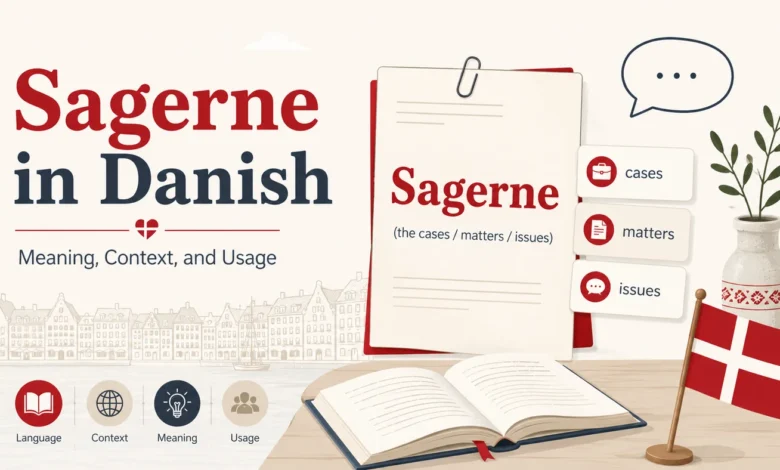
Sagerne is a Danish term that may look small at first, but it carries a lot of meaning. In English, it is often translated as “the cases,” “the matters,” or “the issues.” The best choice depends on the sentence around it.
This term appears in daily speech, news reports, legal writing, office messages, and public discussion. That is why a direct one-word translation can feel weak. You need to understand the situation before choosing the right English meaning.
For English speakers in the US, UK, and other countries, Sagerne is useful because it shows how Danish builds meaning through word endings. Once you understand this form, many similar Danish nouns become easier to read.
It is also a good example of how language reflects daily life. A single Danish noun can move from a courtroom to a workplace meeting, then into a friendly conversation, while still keeping the same basic idea.
Table of Contents
ToggleWhat Sagerne Means in Simple English
Sagerne comes from the Danish noun “sag.” A “sag” can mean a case, matter, issue, affair, cause, or legal case. When it becomes Sagerne, the meaning changes to a definite plural idea: “the cases” or “the matters.”
The term does not always point to court cases. It can also refer to topics being discussed, problems being handled, tasks under review, or public matters that people care about. Context is the key.
For example, in a workplace, it may mean the matters on a manager’s desk. In a court setting, it may mean the legal cases being heard. In a newspaper, it may mean the issues that are part of a public debate.
A simple way to understand it is to think of “sag” as one item of concern. When there is more than one, and those items are already known, Danish can use Sagerne.
The Grammar Behind Sagerne
Danish often places “the” at the end of a noun instead of using a separate word before it. In English, we say “the case.” In Danish, the definite form is built into the noun, so “sag” becomes “sagen” for “the case.”
Sagerne is the plural definite form. It means the speaker is not talking about any cases, but about specific cases already known, already mentioned, or clear from the situation.
This structure is important because it gives the term a more focused meaning. It does not simply mean “cases.” It means “the cases,” with a clear sense that both speaker and listener know which cases are being discussed.
The ending matters because Danish uses noun forms to show number and certainty. English often uses separate helper words, but Danish can place that work inside the noun itself.
Why Context Changes the Translation
The same Danish form can have different English translations because English uses many separate words for ideas that Danish may group under one noun. Sagerne can sound legal, professional, social, or casual depending on where it appears.
If someone says the term during a meeting, “the matters” may sound better than “the cases.” If it appears in a court report, “the cases” is usually more natural. If it appears in a political article, “the issues” may fit better.
This is why translation is not only about matching words. It is also about matching tone, setting, and purpose. A good translation should sound natural to the reader while keeping the original meaning.
A sentence may also include clues such as a court, a report, a department, a complaint, or a public debate. Those clues help you decide whether the term is formal, legal, or general.
Sagerne in Legal and Court Language
One of the clearest uses of Sagerne is in legal settings. Danish legal writing often uses “sag” for a case, dispute, proceeding, or matter handled by a court, lawyer, agency, or authority.
In this setting, Sagerne usually means “the cases.” It may refer to several trials, complaints, investigations, or legal files. The term can appear when discussing how cases are opened, reviewed, delayed, settled, or decided.
A sentence about “sagerne” in court should not be translated as “the things.” That would sound too casual. “The cases,” “the proceedings,” or “the legal matters” will usually be stronger and clearer.
This legal use is important because it can affect tone. A formal document needs careful wording, especially when it describes people, decisions, or official actions.
Sagerne in News and Public Debate
News writers may use Sagerne when covering public topics, scandals, policy debates, or official decisions. In this setting, the term can point to several related matters that are being discussed by the public.
It may refer to government decisions, school problems, workplace disputes, housing complaints, or social concerns. The English translation may shift between “the issues,” “the matters,” and “the cases.”
This makes the term flexible. It can connect personal stories with bigger public questions. A journalist may use it to group several events under one wider discussion.
Readers should pay attention to the subject of the article. If the story is about politics, “the issues” may feel natural. If it is about investigations, “the cases” may be better.
Sagerne in Offices and Daily Work
In an office, Sagerne can refer to tasks, client files, open matters, customer cases, or items waiting for review. It has a practical tone and often points to work that needs attention.
A manager might discuss which matters have been completed and which still need action. A team may use the term when talking about files, requests, complaints, or service cases.
In this setting, “the matters” or “the cases” can both work. The best English choice depends on the type of work. Customer service usually favors “cases,” while business planning may favor “matters.”
This office use is common because many organizations track work as separate items. Each item may have a status, owner, deadline, and result.
Everyday Conversation and Natural Tone
Danish speakers can also use Sagerne in normal conversation. It may refer to things people are dealing with, topics they have been talking about, or problems that need to be sorted out.
The tone can be serious or relaxed. If friends are talking about personal problems, the term may mean “the issues” or “the matters.” If the topic is formal, “the cases” may still fit.
English speakers should avoid translating it too sharply in casual speech. Sometimes “the things we talked about” or “the matters” may sound more natural than a direct translation.
Tone is especially important in spoken language. The same term can feel calm, serious, or urgent depending on the speaker’s voice and the situation around it.
Common Mistakes English Speakers Make
The most common mistake is thinking Sagerne always means legal cases. Legal meaning is common, but it is not the only meaning. The term can also be used in business, news, education, and everyday discussion.
Another mistake is ignoring the definite plural ending. If you translate it as “cases” instead of “the cases,” you may lose part of the meaning. Danish uses the ending to show that the noun is specific.
A third mistake is choosing a stiff English word when a simple one is better. If the setting is casual, “the matters” or “the issues” may be more readable than “the proceedings.”
A fourth mistake is reading the term in isolation. Danish meaning often becomes clearer when you look at the sentence before and after it.
How to Translate Sagerne Correctly
A strong translation begins with the setting. Ask what kind of text you are reading. Is it legal, political, professional, or casual? That will guide your English choice.
You should also check what came before the term. If the cases or matters were already named, the definite meaning becomes clear. English should reflect that with “the.”
Useful translation choices include:
- “the cases” for courts, records, complaints, or client files
- “the matters” for business, office, or general discussion
- “the issues” for public debate, problems, or social topics
- “the affairs” in rare formal contexts where events or concerns are being grouped
After choosing a translation, read the full English sentence aloud in your mind. If it sounds too formal, too casual, or too narrow, choose a better match.
Related Danish Forms You Should Know
To understand Sagerne well, it helps to know the related forms. The base form is “en sag,” meaning “a case” or “a matter.” The definite singular form is “sagen,” meaning “the case” or “the matter.”
The plural indefinite form is “sager,” meaning “cases” or “matters.” The plural definite form is Sagerne, meaning “the cases” or “the matters.” This pattern shows how Danish builds meaning step by step.
Learning these forms together is better than memorizing one form alone. You begin to see how number and definiteness work in Danish nouns.
This also helps with reading. When you see a familiar ending, you can often guess whether a noun is singular, plural, general, or specific before checking a full translation.
Why This Term Matters for Danish Learners
Sagerne is useful for learners because it appears in many real-life areas. You may see it in emails, articles, subtitles, official pages, and conversations. It is not a rare classroom term.
It also teaches a wider lesson about Danish. Small endings can carry important meaning. Missing one ending can change how specific or general a sentence feels.
For learners, this term is a good reminder to slow down and read the whole sentence. When you notice the form, the number, and the setting, the meaning becomes much clearer.
It can also build confidence. Once you understand one form like this, you can use the same idea to understand many other Danish nouns.
Final Thoughts
Sagerne is a practical Danish term with more depth than a simple dictionary meaning. It can mean “the cases,” “the matters,” or “the issues,” but the right English choice depends on context.
The term is especially common in legal, news, work, and public discussion settings. It can point to official files, social problems, open topics, or personal matters already known to the speaker and listener.
If you remember one thing, remember this: Sagerne is specific and plural. It does not refer to random matters. It refers to particular cases or issues that are already part of the conversation.
For anyone learning Danish or translating Danish into English, this term is worth knowing well. It is simple on the surface, but it shows how grammar, meaning, and real-world use work together.
Frequently Asked Questions (FAQs)
What does Sagerne mean in English?
Sagerne usually means “the cases,” “the matters,” or “the issues.” The best translation depends on whether the sentence is legal, professional, public, or casual. You should always read the surrounding sentence before choosing one English meaning.
Is Sagerne a Danish word?
Yes, it is a Danish word. It comes from “sag,” which can mean a case, matter, issue, affair, cause, or legal case in English. The form is common enough to appear in formal writing and normal conversation.
Is Sagerne singular or plural?
Sagerne is plural. More specifically, it is the definite plural form, so it refers to specific cases or matters, not general ones. In English, that small difference is usually shown with the word “the.”
Can Sagerne mean legal cases?
Yes, it can. In court, law, police, or official writing, it often means “the cases” or “the legal matters.” In less formal writing, the same form can point to general matters or public issues.
How is Sagerne different from sager?
“Sager” means “cases” or “matters” in a general plural form. Sagerne means “the cases” or “the matters,” so it points to known or specific items.
Why is Sagerne hard to translate?
It is hard to translate because it changes with context. English may need different words such as “cases,” “matters,” “issues,” or “legal matters” to match the same Danish form. A natural translation should keep the meaning clear without sounding forced.
Read More: Willowmagazine.co.uk
 Admin
Send an email
June 10, 2026
Admin
Send an email
June 10, 2026