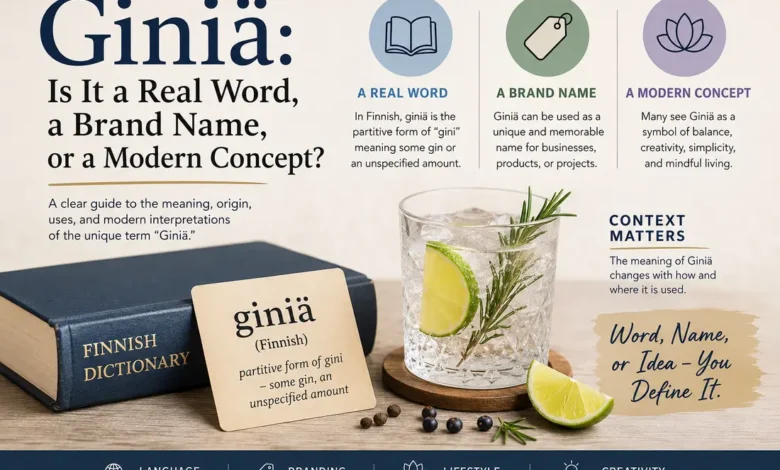
Giniä is the kind of term that makes people pause. It looks familiar, yet the final letter gives it an unusual shape. Some readers see a stylish name, while others assume it describes a new lifestyle idea or digital trend.
The clearest answer begins with language. Written in lowercase, giniä is a genuine Finnish word form. It comes from the Finnish noun “gini,” which means gin, the juniper-flavored spirit. The ending changes because Finnish uses grammatical cases to show how a noun works inside a sentence.
That language origin does not stop people from using Giniä in other ways. With a capital letter, it can become a name for a company, product, studio, account, or creative project.
However, claims that it is an ancient philosophy or a universally recognized modern movement should be treated carefully. Its meaning depends on context. Understanding that difference is the best way to use the term accurately and avoid repeating unsupported stories.
What Does Giniä Actually Mean?
In standard Finnish, giniä is the partitive singular form of gini. In simple terms, it usually refers to an unspecified amount of gin rather than one complete, countable item. English often expresses the same idea without changing the noun.
For example, a Finnish sentence meaning “I would like gin” may use giniä because the speaker wants an unspecified amount. The form also appears in recipes, tasting notes, and conversations about drinks.
Ideas such as calm living, personal energy, or artistic balance may be attached to the spelling by individual writers, but they are not its established Finnish meaning.
Capitalization also matters. Lowercase giniä normally functions as ordinary Finnish vocabulary. Uppercase Giniä may signal a title, product, label, username, or invented proper name. The surrounding sentence usually tells the reader which meaning is intended.
The Finnish Grammar Behind the Word
Finnish changes noun endings to express relationships such as location, direction, quantity, and the role of an object. These changes are called grammatical cases.
The partitive case is especially common. It can describe an incomplete amount, an uncountable substance, an ongoing action, or something without a clear endpoint. Food, liquids, and materials often use it.
The basic noun is gini. When the partitive ending is added, it becomes giniä. Similar changes happen to many other Finnish nouns, so the final ä is not an ornamental mark placed on an English word. It is part of a working grammatical pattern.
Everyday English equivalents include “some gin,” “a little gin,” “three parts gin,” or “I am drinking gin.” The precise translation depends on the sentence.
Why the Letter Ä Matters
The character ä is a full Finnish letter, not simply a decorated a. It represents a front vowel sound and appears in ordinary words and endings. Removing the dots changes the spelling and pronunciation.
English speakers often call the two dots an umlaut because that term is familiar from German. In Finnish writing, however, ä is normally treated as its own alphabetic letter. It is not added to suggest luxury, mystery, or a Nordic mood.
When Giniä is used as a created name outside Finnish, the letter may take on a visual role. Designers may choose it because it appears elegant, modern, international, or memorable. That is a branding choice rather than proof of a deeper cultural meaning.
It may look distinctive in a logo, but it also belongs to a real language system. It should not be treated as random decoration.
How Is Giniä Pronounced?
A Finnish speaker would normally pronounce the letters clearly and place the main stress near the beginning. The word can be divided roughly into three parts: gi-ni-ä. The final sound is closer to the vowel in the English word “cat” than to the relaxed “uh” in “sofa.”
English-friendly spellings such as “gee-nee-ah” are only rough guides and do not fully capture the Finnish vowels. A brand owner may also choose a different pronunciation.
If Giniä becomes a proper name, its creator may decide how it should be spoken. That freedom is common with invented labels. Still, a company using a Finnish-looking form should explain its preferred pronunciation instead of assuming every customer will guess it correctly.
A short audio sample is useful in videos, customer service, and international sales because it prevents competing versions from becoming common.
Is Giniä a Brand Name?
Giniä can function as a brand name, but the spelling alone does not identify one single global company. A word may be used creatively without being owned everywhere, and similar names can exist in different industries or countries.
The form is short, visually unusual, and flexible enough for beauty, fashion, design, hospitality, media, wellness, or software. It also suits a compact logo.
Before adopting it, a business should complete practical checks: • review company and trademark records in every target market; • confirm suitable domain and social account availability; • test spelling and pronunciation with real users; • examine possible meanings in Finnish and other relevant languages.
A memorable name can still create problems. People may type Ginia, keyboards may hide ä, and Finnish readers may understand the word as a form of gin.
Why It Can Look Like a Modern Concept
Unfamiliar words often invite people to fill in the blanks. Because Giniä is short, soft in appearance, and not widely understood by English speakers, it can easily be presented as a symbol of simplicity, creativity, calm, or personal expression.
Such meaning is created through repeated use. A wellness project could define it as intentional living, while a design studio could connect it with clean forms and thoughtful materials.
Those uses can be valid within a clearly explained project. The problem begins when a newly invented definition is presented as an old cultural truth. A concept does not become historically established simply because several websites repeat the same description.
The safest description is that Giniä may serve as a modern coined label. Its broader message is not fixed unless a specific user or community defines it.
Common Claims and Online Misinformation
Recent articles sometimes describe Giniä as an ancient idea linked with harmony, spiritual wisdom, inner energy, or a lost cultural tradition. These stories often offer no named language, dated text, community, scholar, or historical record that supports the claim.
Other pages connect it with the Gini coefficient, the personal name Virginia, Scandinavian folklore, or a worldwide lifestyle movement. Similar spelling is not enough to prove a shared origin. Each claim needs evidence before it should be treated as fact.
A practical test is to ask simple questions. Where was the term first recorded? Which language produced it? Who used it? Is there a dictionary entry, archived publication, official organization, or traceable founder? Vague answers usually signal a modern interpretation rather than documented history.
Creative uses are not automatically wrong. They simply need to be separated from established meaning and described as new.
Giniä and the Gini Coefficient Are Different
The Gini coefficient is a statistical measure commonly used to describe inequality in income, wealth, or another distribution. It is named after Italian statistician Corrado Gini. The spelling does not include ä.
Giniä is not the formal name of that measure. Adding the Finnish ending does not create a new economic formula, and the two terms should not be treated as interchangeable in English writing.
An English article discussing inequality should normally use “Gini coefficient,” “Gini index,” or “Gini value.” Finnish case endings in other contexts do not change the name of the measure.
Keeping the terms separate improves accuracy. One concerns Finnish grammar and gin in its ordinary dictionary sense. The other concerns statistics and the study of distributions.
How Context Changes the Meaning
Context is the fastest way to understand what a writer intends. In a Finnish recipe, drink menu, product description, or conversation, giniä will almost certainly refer to gin. Nearby words may describe tonic, juniper, a measured amount, a cocktail, or a flavor.
In a logo or profile name, Giniä may be a proper name. The surrounding material should then explain what the business, product, or creator offers. Capitalization, typography, and a trademark symbol may also point toward commercial use.
In a lifestyle article, it may be an author’s invented concept. Readers should look for a direct definition and check whether the writer clearly labels it as a new framework. Broad emotional language alone does not establish a traditional meaning.
The spelling becomes clearer once the setting is known. Language form, brand identity, and creative concept are separate categories.
Practical Uses in Naming and Creative Work
A creator may use Giniä for a collection, studio, newsletter, fictional place, event, or digital tool. Its open appearance leaves room for storytelling.
The best approach is to define the name in one clear sentence. A visitor should quickly understand whether it represents a service, product, community, or artistic idea. A vague name becomes stronger when the purpose around it is specific.
A plain-letter backup such as Ginia is useful for web addresses, email accounts, and systems that handle special characters poorly. Both versions should lead to the same identity.
Creators should avoid claiming ownership of Finnish culture or presenting an invented history as fact. Honest storytelling can still be imaginative. In many cases, a transparent modern origin is more believable and memorable than a false legend.
Benefits and Challenges of the Name
The main benefit of Giniä is distinction. It is compact, visually balanced, and uncommon in English-language naming. Those qualities may help an audience remember it after seeing it once or twice.
Its flexibility is another advantage. The term does not force a business into one narrow category. A carefully built identity could grow from a small creative project into a broader collection of products or services.
Some people will omit the dots, pronounce it differently, or confuse it with gin, Ginia, Gina, Guinea, or the Gini index. Finnish speakers may see the ordinary grammatical meaning first.
A successful user should plan for both forms, teach the pronunciation, protect the name where appropriate, and explain its purpose consistently. Distinctive spelling attracts attention, but clarity turns that attention into recognition.
Final Thoughts
Giniä is a real word form, but its clearest established meaning is narrower than many online explanations suggest. In Finnish, giniä is the partitive form of gini and commonly means an unspecified amount of gin within a sentence.
As a capitalized name, it can work for a brand, artistic project, or digital identity. The unusual ä is memorable but creates questions about typing, pronunciation, and alternate spellings.
It can become a modern concept when a creator defines it that way. That concept should be presented as new and specific, not as an ancient or universal belief without evidence.
The most accurate conclusion is simple: Giniä can be a word, a name, or an invented idea, but the intended meaning always comes from context.
Frequently Asked Questions (FAQs)
Is Giniä a real word?
Yes. Lowercase giniä is a genuine Finnish grammatical form of gini, the Finnish word for gin. It usually refers to some gin or an unspecified amount within a sentence.
Does Giniä mean balance or mindful living?
Not as an established Finnish definition. A writer or brand may assign those ideas to the name, but that is a modern creative interpretation rather than its standard language meaning.
Is Giniä connected to the Gini coefficient?
No direct connection is established. The Gini coefficient is named after Corrado Gini and measures distribution or inequality, while giniä is a Finnish form related to the drink gin.
Can Giniä be used as a business name?
It may be possible, depending on local company records, trademarks, domains, and industry conflicts. A business should complete legal and market checks before adopting it.
Why does the word end with ä?
In Finnish, ä is a normal alphabetic letter used in words and case endings. In giniä, it forms part of the noun’s grammatical change and is not merely decoration.
What is the best way to explain Giniä?
Start with the context. Explain whether it is Finnish vocabulary, a chosen proper name, or a newly defined creative concept, then state the intended meaning in plain language.
Read More: Willowmagazine.co.uk